



Housekeeping
- Revamped schedule and our final 5 weeks
- Final project instructions: all the deadlines
- Quiz for our course (required by CTELT)
—————————————————————————————————-
Wyatt and the English Sonnet, and Henry Howard, the Earl of Surrey
- worked for Henry VIII as courtiers
- As Henry VIII’s ambassador, Wyatt traveled abroad
- Brought love sonnet to England from Italy.
- Wyatt began by translating Petrarchan poetry, which typically included:
- An extended metaphor (conceit)
- 14 lines of iambic pentameter with alternating rhymes (ABBA in octave/first 8 lines; CDCDCD or other three-paired rhymes for the sestet)
- A turn (volta) before the sestet (last six lines)
- The English sonnet is 3 quatrains (sets of 4 lines; ABAB CDCD EFEF) and a closing couplet (2 lines; GG)
- Wyatt began by translating Petrarchan poetry, which typically included:
- Surrey first used unrhymed iambic pentameter in a translation of parts of Virgil’s Aeneid
- Neither of them published their poems, since they were expected to compose songs and verses to entertain the King and not for profit
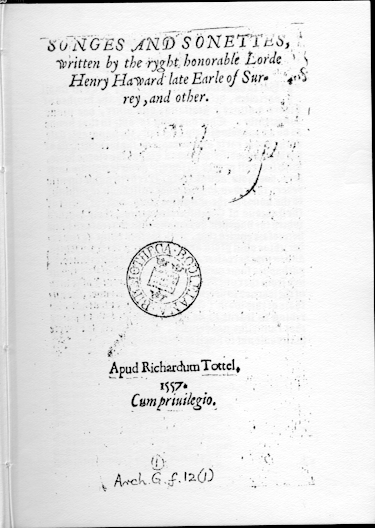
- 10 years after Surrey’s death (Wyatt died first), Richard Tottel published Songs and Sonnets – 96 of Wyatt’s poems and 40 of Surrey’s
- Tottel changed some of the words around, however, so it is now popularly known as Tottel’s Miscellany
- BUT: Not every poem in Tottel is a sonnet, and many are not by either of the named authors in the title
Audiences
- Original audience aristocratic; Tottel aims to change that
- Except…in doing so, he takes a lot of their writing out of context
- According to Verse Miscellanies online:
The ideal reader interpellated in the pages of Tottel’s Miscellany and those miscellanies that followed its example, such as Paradise of Dainty Devices, is often said to be that of the ‘gentleman reader’. Wendy Wall argues that these miscellanies ‘marketed exclusivity’ and ‘functioned as conduct books’ that ‘demonstated to more common audiences the poetic practices entertained by graceful courtly readers and writers’ (Wall; Heale 2003a, 14-15; Nebeker, 989-1003). Elizabeth Heale has taken this argument a step further to point out that the ideal ‘gentleman reader’ fashioned within the miscellanies also functioned to exclude the gentlewoman as both composer and reader of lyric poetry: ‘For the mid-century miscellanists, the writing of courtly verse was primarily a gentlemanly activity in which the active participants were almost exclusively male, and in which the attitudes and gestures marketed as socially desirable contributed to the construction of a desirable mid-century masculine self, humanist-educated and socially aspiring’ (Heale 2003b, 233).
Verse Miscellanies
- Tottel innaugurated what became one of the most popular printed genres:the verse miscellany. This was a collection of poems by several authors, typically though not always on a theme, which promised to offer access to a previously-hidden type of writing that used to be exclusively circulated among the aristocracy
- Other miscellanies in the period include: Paradise of Dainty Devises (1576-1606), Gorgeous Gallery of Gallant Inventions (1578), Handful of Pleasant Delights (1584), Phoenix Nest (1593), England’s Helicon (1600, 1614), and Poetical Rhapsody (1602-21)
Commonplace books

- For centuries before (and after) the invention of print, individuals preserved, shared, and reproduced information through commonplace books. In these books, they recorded quotes, recipes, financial accounts, and even practiced their handwriting.
- Commonplace books were also richly collaborative, and much of the early literary production (particularly for poetry) was produced in “coteries,” or groups of like-minded, educated aristocrats (including women) who edited, revised, and responded to each other’s writing.
- Take a look at what some readers wrote about Shakespeare or Jane Austen
- Commonplacing wasn’t born in the early modern period, but it because popularized as a form of education, menory, and record-keeping. It was as much a diary as it was a planner or sketchbook, not much different from what we do now online with places like Pinterest or Tumblr.
- Again, we hear from VM Online on what readers annotated on printed books:
A number of the notes that contemporary readers made in their copies of the miscellanies are recorded in the notes to this edition. Annotations take a range of forms, from marks placed against whole poems or lines of poetry to editorial notes. Readers mark poems for a variety of reasons: to indicate their own appreciation of a verse or to show to a companion, or to mark poems or lines to copy into their commonplace books. Such marks can provide evidence for individual and shared tastes, and changing literary fashions. Other marks function editorially. A copy of the 1596 edition of Paradise of Dainty Devices in the Folger library (F: cs0361), for example, has a note beside the title of the song said to have been composed by the first Earl of Essex on his death bed (‘O Heavenly God, O Father dear, cast down thy tender eye’), indicating that it is to be sung ‘To the Tune of Rogero’; similarly a contemporary hand noted beside the title of ‘Fair Phillis and her Shepherd’ in a copy of England’s Helicon in the British Library (L: C.39.e.48 ) that it was to be sung to the ‘tune of crimson velvet’. A copy of the 1587 edition of Tottel’s Miscellany in the Bodleian Library (O: Seld. 8o H.43.Art) has numerous annotations that identify sources, for example, noting against ‘Some men would think of right to have’ that it is ‘Taken out of Tully’, or other explanatory notes, such as, that the ‘gander’s foe’ in Surrey’s ‘Though I regarded not’ is ‘the sow or hog or rather fox’.
Close-reading the poems…








Leave a Reply
You must be logged in to post a comment.